

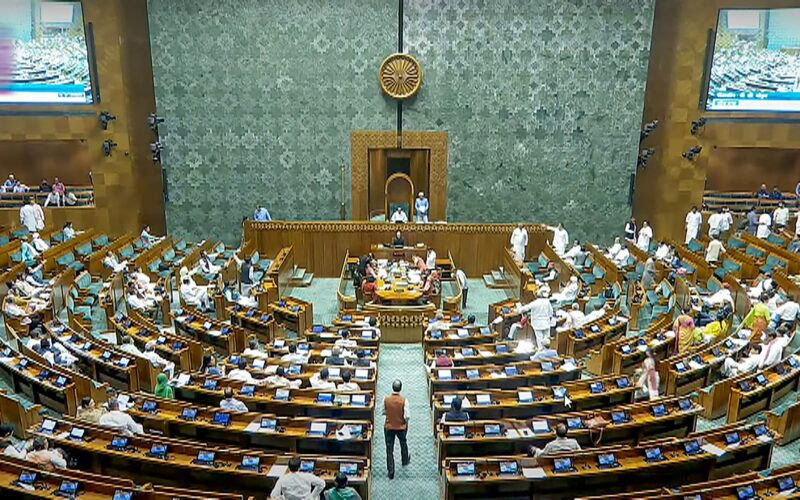
New Delhi (Gurpreet Singh): The Centre is preparing to introduce three fresh bills to implement 33 per cent reservation for women in the Lok Sabha and state legislative assemblies before the 2029 general elections. The government is reportedly confident of securing their passage after revising key provisions to address concerns raised by opposition parties, particularly those from southern states.
According to official sources, the proposed legislation will include a 50 per cent increase in the number of parliamentary constituencies in each state, with the total strength of the Lok Sabha potentially rising to a maximum of 850 seats.
The proposed changes are aimed at building wider political support after an earlier delimitation-related legislative effort was defeated in the Lok Sabha in April.
Sources said the government had consulted several political parties and their leaders before deciding to convene a special sitting of Parliament. They expressed confidence that the three bills would pass this time.
How Will The Proposed 50% Increase In Lok Sabha Seats Work?
Under the proposed arrangement, the number of Lok Sabha constituencies in each state will increase by 50 per cent, subject to certain exceptions for smaller Union territories.
The boundaries of parliamentary and Assembly constituencies will be redrawn using the 2011 Census. However, the ratio used to determine the distribution of constituencies will be based on the 1971 Census, according to the sources.
The arrangement is intended to address concerns among southern states that a delimitation exercise based entirely on more recent population figures could reduce their relative representation in Parliament.
Tamil Nadu’s ruling DMK has specifically demanded that the state’s existing 7.18 per cent share of Lok Sabha seats should not decline. Government sources indicated that the party’s concerns would be addressed.
The proposed freeze on Lok Sabha and Assembly constituency boundaries will remain in place for 25 years, until 2051.
What Are The Three Bills The Centre Plans To Introduce?
The government is expected to introduce two Constitution Amendment Bills, identified as the 131st and 132nd amendments, along with a separate bill dealing with Union territories.
The 131st Constitution Amendment Bill will provide for the constitution of a delimitation commission, while the 132nd Bill will deal with redrawing constituency boundaries.
The third legislation will address the implementation of the proposed changes in Union territories.
Sources said the new delimitation bill would be substantially different from the version defeated in the Lok Sabha in April, with amendments to at least eight Articles of the Constitution.
The government will first withdraw the two existing bills on delimitation and Union territories that are currently pending in the Lok Sabha. The three revised bills will then be introduced for debate and passage.
How Will The 33% Women’s Reservation Be Implemented?
The proposed legislation seeks to implement 33 per cent reservation for women in the Lok Sabha and state Assemblies before the 2029 parliamentary election.
Initially, the reserved constituencies will remain in place for 15 years. The government of the day is expected to consider extending the reservation after that period.
The seats reserved for women will be rotated after every term, according to the plan outlined by the sources.
The proposed framework also provides for a delimitation commission to be constituted immediately so that the exercise can be completed within the intended timeline.
Why Are Southern States Concerned About Delimitation?
The delimitation exercise has been a politically sensitive issue, particularly for southern states that have raised concerns about the impact of population-based seat redistribution.
States such as Tamil Nadu argue that they should not lose their share of representation in Parliament because they have made progress in population control.
Using the 1971 Census to determine the ratio of constituencies, while relying on the 2011 Census for drawing boundaries, is intended to address these concerns.
The proposed 50 per cent increase in seats is also expected to give states additional representation without reducing their existing relative share.
For smaller Union territories such as Lakshadweep and the Andaman and Nicobar Islands, the 50 per cent increase will not apply. However, the formula could lead to an increase in representation in smaller states such as Nagaland and Mizoram, where the number of Lok Sabha seats may rise from one to two.
How Much Time Will Parliament Get To Debate The Bills?
The government is expected to allot around 10 to 12 hours for debate on the proposed legislation, followed by approximately five hours for voting.
Although ratification by at least 50 per cent of state legislatures is reportedly not mandatory for these constitutional amendments, the government intends to seek such approval as a matter of convention.
The proposed legislation will be crucial to the government’s plan to implement women’s reservation before the 2029 Lok Sabha elections. However, the bills will first have to clear Parliament, followed by the proposed delimitation and constituency reorganisation process.
