

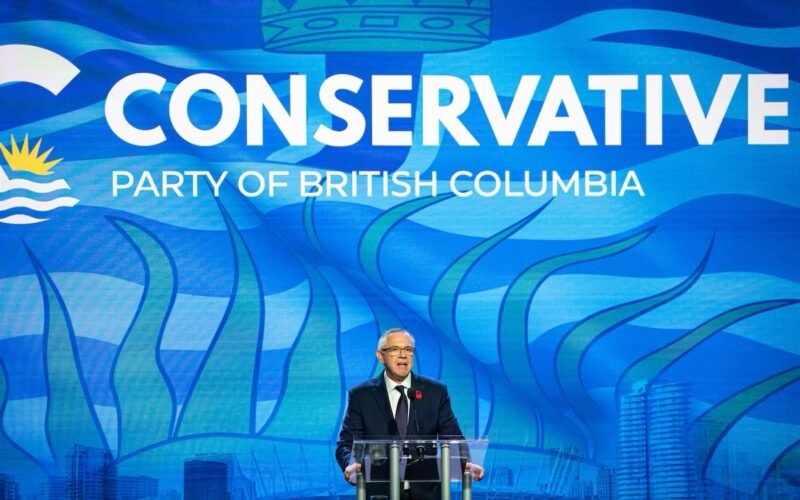
Vancouver (Rajeev Sharma): The Conservatives, led by John Rustad, won 46 of British Columbia’s 93 legislative seats in the Oct. 24 provincial election, while the New Democratic Party (NDP), led by Premier David Eby, won 45. The Green Party, led by Sonia Furstenau, won two seats. One riding remained unresolved at the time of the initial results, leaving the Conservatives short of the 47 seats required for a majority. The Conservatives received approximately 44.1 per cent of the popular vote, compared with about 42.3 per cent for the NDP and 8.3 per cent for the Greens.
Eby acknowledged the defeat and offered to resign as NDP leader. The result marks a major shift in B.C. politics, with voters turning away from the governing NDP after nearly a decade in office. Rustad is expected to seek the opportunity to form government, but he cannot be described as having secured a majority until the unresolved riding is decided and the final results are confirmed. The lieutenant governor will determine whom to invite to form the ministry in accordance with constitutional convention.
The incoming government will face immediate pressure on housing affordability, health-care access, public safety, infrastructure and the cost of living. Rustad will also need to manage the transition from the NDP government while presenting a legislative agenda that reflects the priorities outlined during the campaign.
Eby said he accepted responsibility for the party’s loss and would step aside as leader, although he is expected to remain premier until a successor is chosen or another government is sworn in, subject to constitutional convention and the lieutenant governor’s decisions. His resignation will trigger a leadership contest within the NDP and open a new chapter for the party in opposition.
The Conservatives’ strong showing follows a closely watched campaign in which the party sought to capitalize on dissatisfaction with the NDP’s record and present itself as an alternative government. With one riding unresolved, the final balance of power remained uncertain at the time of the initial results. Even if the Conservatives ultimately secure a majority, their margin would be narrow; if the unresolved seat goes to another party, they could face the need to negotiate support for legislation.
The change in government, if the Conservatives are invited to form one, could bring significant policy differences, particularly in areas such as taxation, resource development, public safety and health-care delivery. Any new administration would also inherit ongoing challenges involving housing supply, homelessness, strained hospitals and relations with municipalities and Indigenous communities.
For the NDP, the defeat begins a period of rebuilding. The party will have to select a new leader, assess its campaign and determine how to respond to the Conservatives’ agenda from the opposition benches. The Green Party’s two seats could give it influence in public debate and, depending on the unresolved result and the government’s final seat count, potentially in legislative negotiations.
The election result represents one of the most consequential changes in British Columbia politics in years. As the parties await the final result and the constitutional transition process, voters and political observers will be watching to see who forms government and whether the next premier can translate campaign promises into action and address the province’s pressing problems.
