

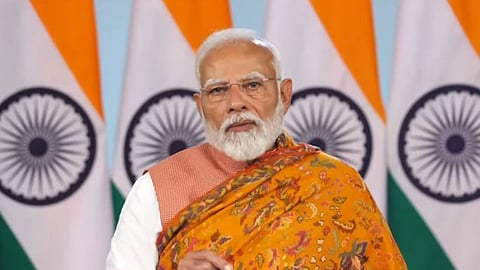
Faridkot (Gurpreet Singh): A rural initiative from Jaito in Punjab’s Faridkot district received national recognition during Prime Minister Narendra Modi’s monthly radio programme Mann Ki Baat, as he highlighted how Nav-Trinjan is promoting organic cotton, traditional handloom weaving and women’s economic independence.
The initiative, run by the Jaito-based Kheti Virasat Mission (KVM), brings together natural cotton cultivation and handmade textile production. During Sunday’s broadcast, Modi spoke about how cotton grown without chemical fertilisers and pesticides is spun into yarn, woven into fabric and coloured using natural dyes.
He also credited the effort with helping revive traditional agricultural practices, supporting farmers and creating opportunities for women to earn a livelihood.
The Prime Minister mentioned four women associated with the project — Ramandeep Kaur, Rajni Kaur, Rekha Rani and Sneha Devi — who met him in New Delhi on National Handloom Day. A shawl made through the Nav-Trinjan initiative was also presented to the President of India on the occasion.
Reviving Punjab’s traditional ‘Trinjan’
The project takes its name from trinjan, a traditional Punjabi gathering where women would sit together to spin cotton on charkhas, sing folk songs and share their everyday experiences. As industrialisation changed rural lifestyles, such gatherings gradually declined.
Nav-Trinjan seeks to bring that tradition back while creating a livelihood-based model centred on women. According to KVM executive director Umendra Dutt, the initiative connects the entire textile process, beginning with organic cotton cultivation and extending to spinning, dyeing, weaving and the finished product.
The cotton is sourced from farmers associated with KVM who practise natural farming and grow traditional non-BT varieties. The initiative has received PGS-India certification for its farming network and CRAFTMARK certification to authenticate handmade products.
Weaving school trains a new generation
A key part of the programme is the Nav-Trinjan Bunkar Pathshala, where experienced artisans teach weaving skills to young people from weaving families.
Master artisans Shinder Kaur and Gurmeet Kaur, who have limited formal education but extensive practical experience, train young women and men in traditional loom techniques. Dutt said around 30 rural women have received training through the school over the past two years.
Among those who have benefited is Ramandeep Kaur from Chaina village. A mother of three, she previously relied on temporary work under the Mahatma Gandhi National Rural Employment Guarantee Act (MGNREGA) and had never worked on a handloom before joining the initiative in 2024. She now earns a regular income that helps support her children’s education.
Rekha Rani, a homemaker from Jaito who had no prior experience in handicrafts, also found employment through the programme.
Both women were selected by the Union Textiles Ministry to participate in a two-day national workshop in Delhi under the Mahatma Gandhi Gram Swaraj initiative.
Rupsi Garg, director of KVM’s Rural Development and Heritage Conservation Division, said women who had little or no previous exposure to spinning and weaving were now representing Punjab at national-level events.
Handmade textiles connect farmers and consumers
Nav-Trinjan recently organised a nine-day exhibition in Jaito showcasing organic cotton fabrics, handspun yarn, khadi, dupattas and naturally dyed textiles. The products reflected the work of farmers, spinners, dyers and weavers involved at different stages of production.
The initiative’s recognition on Mann Ki Baat has brought attention to a model that combines traditional craft, natural farming and employment for rural women. For its participants, the effort offers not only a way to preserve Punjab’s textile heritage but also an opportunity to earn an income through skills passed down and developed within rural communities.
