

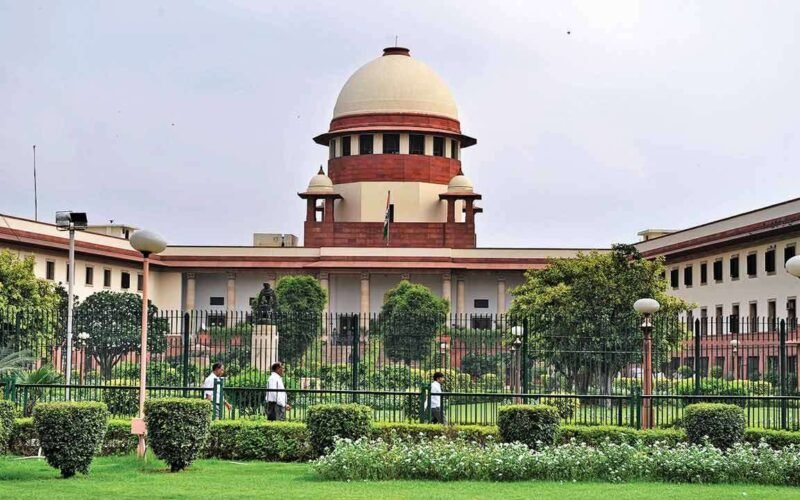
New Delhi (Gurpreet Singh): The Supreme Court on Thursday made strong observations about the commutation of death sentences, saying India’s “forgiving nature” had to reach a point where a line was drawn. The remarks came while a bench was hearing the premature release plea of Sanjeev Kumar, a Haryana convict sentenced to death in a multiple-murder case.
“It is because of our forgiving nature that India is facing these problems. Forgive, forgive, forgive, you have to draw a line somewhere,” the bench of Justice Dipankar Datta and Justice Sheel Nagu said.
The court reserved its verdict on Kumar’s plea, which seeks premature release under the Haryana government’s 2002 remission policy. The judges also referred to a previous case in which the Supreme Court commuted a man’s death sentence after he had been convicted of raping and murdering his elder daughter. The man later murdered his wife after being released on parole, according to the bench’s account of the case.
Why Did The Supreme Court Criticise The Commutation Of Death Sentences?
During the hearing, Justice Datta questioned whether the approach to awarding death sentences in murder cases needed to be reconsidered in light of changing circumstances.
“Times have changed. In earlier days’ murder leading to death (sentence) was on the basis of rarest of rare cases, because murders were rare. Is it the same now?” he asked.
The remarks focused on the court’s role in deciding when the death penalty should be imposed and when a sentence should be commuted to life imprisonment.
The judges cited a case involving a man convicted of raping and murdering his elder daughter. His death sentence was commuted to life imprisonment, after which he was released on parole and murdered his wife in front of their younger daughter, as described by Justice Datta.
The bench questioned the reasoning behind the earlier commutation, pointing out that the sentence was subsequently restored to death after the second murder, only to be commuted again by the Supreme Court.
Who Is Sanjeev Kumar And Why Is He Seeking Premature Release?
Sanjeev Kumar was sentenced to death in May 2004 after being convicted in a multiple-murder case.
The Punjab and Haryana High Court commuted his death sentence to life imprisonment in 2005. In 2007, the Supreme Court reversed that decision and restored the death penalty.
After the Governor and the President rejected his mercy petitions, Kumar approached the Supreme Court again. In January 2014, the court commuted his death sentence to life imprisonment, citing the inordinate delay in deciding his mercy plea.
Kumar is now seeking premature release under the Haryana government’s 2002 remission policy. He has argued that he has completed 20 years of actual imprisonment and meets the eligibility conditions for consideration.
What Is The Haryana Government’s Stand On His Release?
The Haryana government has opposed Kumar’s plea for premature release.
The dispute concerns whether Kumar should be released after completing the required period of imprisonment under the applicable remission policy. Eligibility for consideration under a policy does not automatically guarantee release.
The Supreme Court heard the matter and reserved its verdict on Thursday. The final decision will determine the outcome of Kumar’s current plea.
What Did The Supreme Court Say About The ‘Rarest Of Rare’ Doctrine?
The death penalty in India is generally governed by the “rarest of rare” doctrine, under which capital punishment is reserved for exceptional cases after judicial consideration of the circumstances.
During Thursday’s hearing, Justice Datta questioned whether the reasoning behind the doctrine needed closer examination as the court considers the changing nature and frequency of serious crimes.
The bench’s comments were made during arguments in Kumar’s case. They should not be treated as a final ruling changing the legal standard for awarding the death penalty.
The court has reserved its verdict on the premature release plea.
