

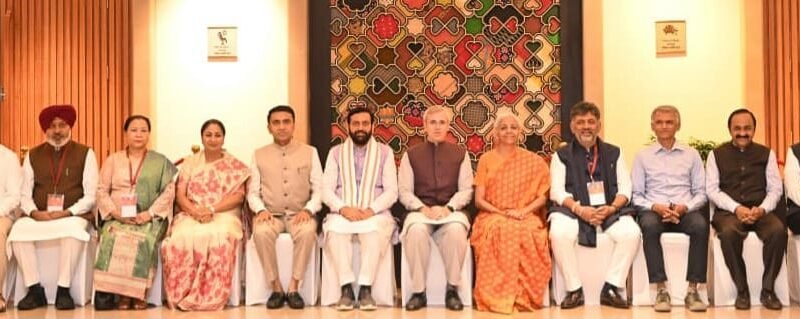
Chandigarh (Balwinder Singh): Haryana Chief Minister Nayab Singh Saini said the state ranked fifth among Indian states in gross GST collection in September 2026, collecting Rs 10,097 crore despite accounting for around 1.3% of the country’s geographical area and 2% of its population.
Saini made the remarks at the 57th GST Council meeting, chaired by Union Finance Minister Nirmala Sitharaman at Bharat Mandapam in New Delhi on October 8.
The Chief Minister also presented three proposals aimed at easing compliance-related difficulties for taxpayers, improving coordination between central and state GST authorities, and protecting eligible input tax credit (ITC) claims.
How Much GST Did Haryana Collect In September 2026?
According to figures shared by Saini at the meeting, Haryana collected Rs 10,097 crore in gross GST in September 2026. This accounted for more than 7% of India’s domestic GST collection and placed the state fifth among states.
The Chief Minister also highlighted Haryana’s annual and half-yearly revenue growth.
For the financial year 2025–26, Haryana’s state GST revenue, including its share of IGST settlement, increased from Rs 39,743 crore to Rs 48,289 crore, representing growth of around 22%, according to the figures presented at the meeting.
During the first six months of the current financial year, state GST revenue reached Rs 29,108 crore, compared with Rs 23,058 crore in the corresponding period a year earlier. That represented growth of approximately 26%, against a national average of 16%, Saini said.
What Are Haryana’s Three Proposals At The GST Council?
Saini presented three proposals intended to address difficulties faced by taxpayers and improve the functioning of GST administration.
The proposals cover a one-time opportunity to file delayed appeals in certain cases, technology-based coordination between central and state enforcement authorities, and safeguards relating to retrospective cancellation of GST registration.
Why Has Haryana Proposed One-Time Relief For 646 Tax Cases?
Haryana has proposed another one-time window for filing appeals against orders relating to the initial years of GST, covering financial years 2017–18 to 2019–20.
Saini said a limited opportunity to file appeals had been provided in November 2023, but 646 cases in Haryana had still been dismissed solely because of delays in filing.
These cases involve demands totalling Rs 567.43 crore, according to the figures shared by the Chief Minister.
Haryana wants the proposed relief to cover demands involving tax, interest and penalties, including cases in which the demand relates only to interest or penalties and does not include a tax component.
The state has suggested that the GST Council consider recommending a special procedure under Section 148 to provide this limited relief. The proposal is a recommendation for consideration, not an announced nationwide policy change.
What Is Haryana’s Proposal On GST Enforcement?
The second proposal concerns overlapping enforcement action by central and state GST authorities.
Saini said taxpayers sometimes face summons, inspections, investigations and other proceedings from both administrations over the same or related issues. This can require businesses to submit documents repeatedly and spend additional time and resources responding to proceedings.
Haryana has proposed a technology-based mechanism to improve coordination between the two administrations while preserving their respective lawful enforcement powers.
The objective is to reduce duplication and make enforcement more predictable for taxpayers.
How Could Retrospective GST Registration Cancellation Affect Buyers?
The third proposal concerns cancellation of GST registration with retrospective effect.
Saini said the law allows an officer to cancel registration from a date determined by the officer. Haryana has suggested a safeguard under which registration should not be cancelled retrospectively for a period in which evidence establishes that the taxpayer supplied goods or services.
According to the Chief Minister, retrospective cancellation can put the input tax credit claimed by genuine buyers at risk, even when they purchased goods or services from the supplier during the relevant period.
The state wants the rules to better protect eligible buyers while retaining the authorities’ ability to take action where required.
What GST Reforms Did Haryana Support?
Saini welcomed proposals to increase automation and technology use in GST registration, amendments, cancellation and refunds.
He said technology-based risk assessment could help officials identify potential tax evasion while reducing the compliance burden on genuine taxpayers.
Haryana also supported simpler registration for small taxpayers supplying goods or services through e-commerce operators, along with a system-based risk analysis mechanism for processing refunds.
The Chief Minister said these measures could improve transparency, reduce manual intervention and make tax administration more efficient.
Did Lower GST Rates Increase Haryana’s Business Activity?
Saini referred to the simplified GST rate structure implemented from September 22, 2025, following GST Council recommendations.
He said taxes had been reduced on several categories, including motor vehicles and auto parts, tractors and agricultural machinery, cement, electronic goods, textiles, food products, everyday items and medicines. He also referred to exemptions for individual life and health insurance.
According to the figures he presented, turnover among Haryana taxpayers in sectors that received rate reductions was 33% higher than a year earlier. Turnover in tractors and tractor parts rose by 52%, while auto parts recorded growth of 46%.
Saini said revenue had continued to increase despite the lower rates, highlighting the importance of these trends for Haryana’s automobile manufacturing sector.
These figures were presented by the Chief Minister at the meeting and reflect the state’s assessment of the impact of the rate changes.
What Is Haryana’s Plan To Increase GST Revenue?
Saini said the state was working to strengthen its revenue base and improve the use of public resources in line with the goal of Viksit Bharat 2047.
He credited Haryana’s industrialists, traders, service providers and compliant taxpayers for the state’s revenue growth. He also referred to a national conference on strengthening tax revenue held by the Haryana government in Chandigarh on September 30.
The Chief Minister said Haryana would continue cooperating with the Centre and other states on GST reforms intended to simplify compliance and safeguard revenue.
The proposals discussed at the 57th GST Council meeting would require consideration through the relevant Council and government processes before any resulting changes could take effect.
