

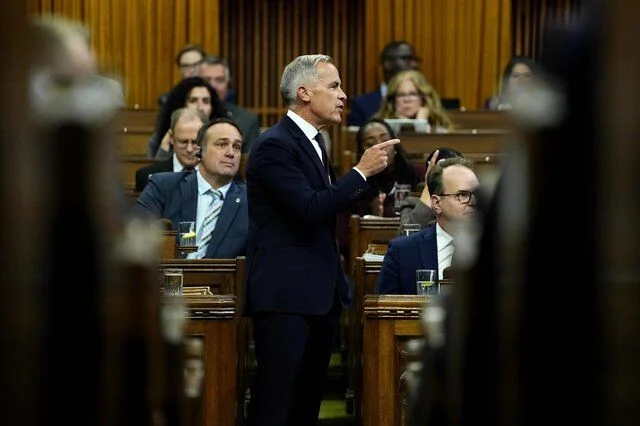
Ottawa (Rajeev Sharma): Prime Minister Mark Carney is preparing to take a direct role in shaping the work of a new federal advisory council focused on artificial intelligence, as the Liberal government seeks to accelerate Canada’s response to the rapidly developing technology.
The newly created council is expected to provide advice across government rather than concentrating on the responsibilities of a single department. The Prime Minister’s Office says Carney will personally help determine the group’s priorities, particularly on issues that involve more than one federal department.
The move reflects growing pressure on governments to keep pace with developments in artificial intelligence. Ottawa has indicated that AI policy will require coordination across areas including the economy, national security, employment, innovation and democratic institutions.
The council brings together prominent figures from Canada’s technology, business and academic communities. Among its members is AI researcher Yoshua Bengio, one of the country’s best-known figures in the field.
Other appointees include Gillian Hadfield, an expert in AI governance and alignment at Johns Hopkins University; University of Toronto computer science professor Sanja Fidler; and Jordan Jacobs, a co-founder of venture capital firm Radical Ventures.
The panel also includes McKinsey special adviser Eric Lamarre, former National Bank chief executive Louis Vachon, former national security adviser Jody Thomas and Senator Thomas Pitfield, who previously served as Carney’s principal secretary.
The government’s broader objective is to develop practical recommendations for Canada’s AI strategy. Areas expected to receive attention include expanding the use of AI, helping Canadian companies compete internationally, developing domestic computing and AI infrastructure, and addressing potential risks associated with the technology.
The council is also expected to examine questions surrounding the safe deployment of AI and its possible effects on democracy and Canadian society.
This latest panel is not the government’s first attempt to bring outside experts into its AI policy process. Ottawa already has an advisory body connected to Innovation Canada, although officials say that group has a more technical mandate and primarily advises the responsible minister.
The government has also established separate groups examining AI’s impact on workers and the cultural sector.
An AI and labour advisory council recently held its first meeting with Artificial Intelligence Minister Evan Solomon. The group includes representatives from major Canadian unions, including Unifor and the Canadian Union of Public Employees, along with organizations representing workers in sectors such as health care, education, construction and food services.
Discussions have focused on preparing workers for technological change, skills development, workplace rights and ensuring that employees are supported as AI becomes more widely adopted.
A separate AI and culture council was established earlier this year to examine how artificial intelligence is affecting Canada’s creative industries. The group was created jointly by Solomon and Culture Minister Marc Miller and is intended to advise the government on both the challenges and potential opportunities AI presents for the cultural sector.
With multiple advisory groups now examining different aspects of artificial intelligence, Carney’s involvement in the latest council signals that the federal government intends to approach AI as a broad policy issue rather than one limited to technology or innovation.
The council’s recommendations could help shape Ottawa’s next steps on AI adoption, regulation, workforce preparation and the development of Canada’s domestic technology capabilities.
