

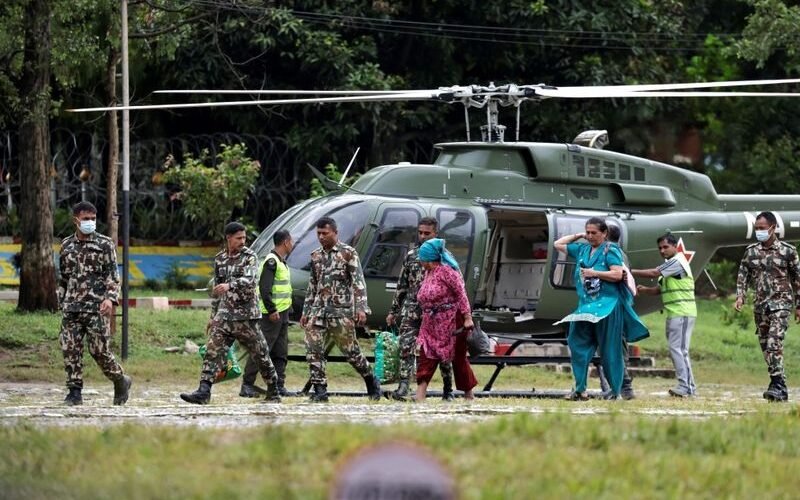
Kathmandu (Rajeev Sharma): An 11-member team from India reached Nepal on Saturday to assist with emergency operations in areas devastated by flash floods that have killed more than 500 people and left close to 2,000 others unaccounted for.
The deployment was made following a request from the Nepalese government, according to sources at the Indian Embassy. The Indian team comprises medical specialists and personnel with expertise in tunnel rescue operations, bringing specialised capabilities to an already extensive search and relief effort.
The team has been sent as Nepal continues to deal with the destruction caused by severe flash floods that swept through Rasuwa and several other parts of central Nepal on Wednesday. The floods damaged settlements and disrupted major infrastructure, including roads, bridges and hydropower projects.
Nepal’s own security forces remain at the centre of the rescue mission. The government said on Friday that it intended to rely heavily on its security personnel because of their knowledge of the country’s mountainous terrain and local conditions.
However, officials have also acknowledged that some rescue situations may require expertise that goes beyond the capabilities available domestically. Foreign Minister Shisir Khanal said Nepal was prepared to accept international assistance for particularly difficult operations involving complex physical structures.
Restoring road connectivity is another pressing challenge for the flood-hit areas. Nepal has approached both India and China for assistance in building 42 Bailey bridges to reopen transport routes disrupted by the disaster.
The prefabricated bridges can be assembled comparatively quickly and are suited to emergency reconstruction because they can be installed without the need for heavy machinery or highly specialised equipment.
With thousands of people still missing and critical infrastructure damaged, rescue agencies face a difficult task in the days ahead. India’s latest deployment is expected to strengthen Nepal’s ongoing efforts to locate survivors, provide medical assistance and support the restoration of essential connectivity.
