

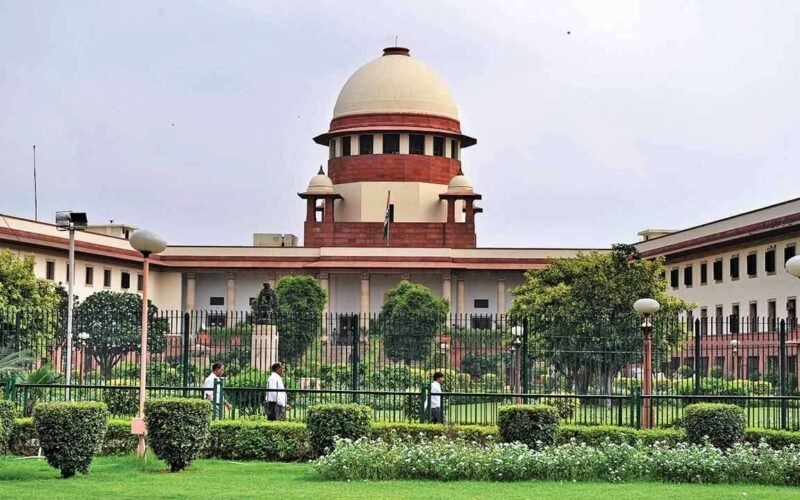
New Delhi (Gurpreet Singh): The Supreme Court has ordered strict action against bulk waste generators (BWGs) that fail to comply with solid waste management norms, directing local authorities to temporarily disconnect their water and electricity supplies in cases of non-compliance.
A Bench of Justices SVN Bhatti and NV Anjaria expressed concern over the lack of public participation in waste management, observing that people cannot simply generate waste without taking responsibility for its impact.
“It is regrettable that across society, the general feeling is ‘I am entitled to generate (waste) but not to cooperate and control the impact of solid waste management at the threshold’,” the Bench observed.
Who Could Face Water And Electricity Disconnection?
Under the enforcement mechanism laid down by the Supreme Court, local bodies will have to inform every bulk waste generator within their jurisdiction about their obligations concerning the segregation, storage and handover of solid waste.
Failure to comply could lead to temporary disconnection of water and electricity following an order from a special cell under the jurisdictional district collector.
The supplies can be restored after the bulk waste generator submits a compliance certificate establishing that the required waste-management norms have been met.
District collectors, in coordination with local bodies, have also been directed to identify all bulk waste generators in their respective jurisdictions within six weeks.
Supreme Court Calls For Waste Management Lessons In Schools
The court also turned its attention to long-term behavioural change, directing the departments of school and higher education to immediately introduce theoretical as well as practical lessons on solid waste management in curricula.
Students should be trained to educate members of their families about responsible waste management, while teachers should be prepared to act as trainers, the court said.
The Bench envisaged trained students functioning as “household-level supervisors” to encourage proper waste management practices at home.
District education departments have been asked to conduct periodic audits and submit reports to the respective district collectors.
‘Waste Is Not Sanitary Workers’ Responsibility Alone’
The Supreme Court rejected the notion that dealing with waste was solely the responsibility of sanitation workers.
“The prevailing assumption that solid waste is a problem for sanitary workers alone, while the rest of the population remains passive generators, is neither legally correct nor practically sustainable,” the Bench observed.
The court also referred to citizens’ fundamental duty to protect the environment and stressed that laws and penalties alone cannot create responsible civic behaviour unless individuals and institutions recognise their own obligations.
Court Seeks Stronger Monitoring Of Waste Management
The court asked authorities to consider using an existing online portal for uploading geotagged photographs of accumulated waste and filing monthly compliance reports.
These reports could move through the administrative chain from district collectors to state secretaries and Union ministries, allowing authorities to track compliance.
Local bodies have also been directed to report how much waste is being generated, how much is accounted for and how much remains unaccounted for, along with measures being taken to improve stakeholder participation.
The directions came while the Supreme Court was hearing appeals filed by the Bhopal Municipal Corporation against National Green Tribunal orders concerning compliance with solid waste management rules.
The Supreme Court Monitoring Committee has also been asked to focus on water pollution caused by municipal solid waste entering rivers and place relevant data before the court for further directions.
The matter has been listed for further hearing on November 17.
