

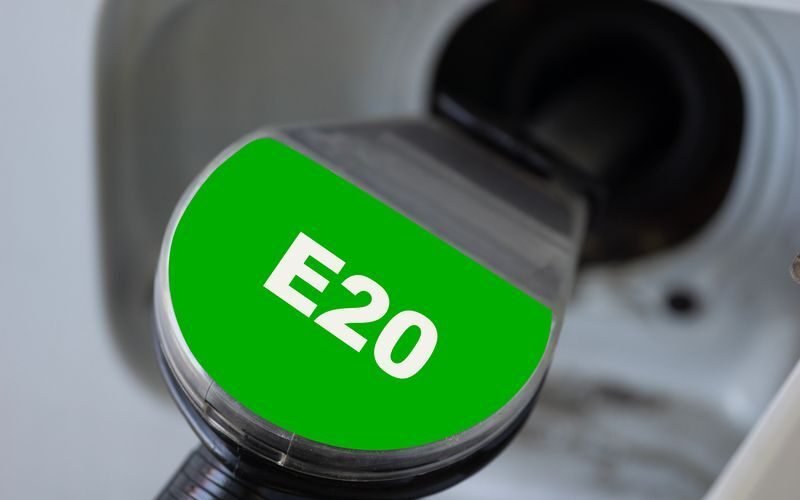
New Delhi (Gurpreet Singh): The central government has not yet taken any decision to increase ethanol blending in petrol past the existing 20 per cent cap, Minister of State for Petroleum and Natural Gas Suresh Gopi informed the Rajya Sabha on Monday. In a written submission, the minister clarified that any prospective expansion of the blending threshold would only be enacted following detailed scientific and technical evaluations alongside extensive consultations with automotive manufacturers, oil marketing companies, and research institutions. India achieved its benchmark 20 per cent blending goal five years ahead of its original target timeline, with average blending expanding from 1.53 per cent in 2013-14 to 20 per cent in the 2025-26 supply year after more than two decades of a phased national rollout.
The financial and environmental indicators submitted by the ministry highlight the significant impact of the Ethanol Blended Petrol programme since 2014-15. The domestic green energy initiative has successfully saved over 1.97 trillion rupees in foreign exchange reserves, displaced approximately 316 lakh tonnes of imported crude oil, and mitigated around 952 lakh tonnes of carbon dioxide emissions. Concurrently, the programme has delivered substantial economic support to the agricultural sector, generating more than Rs 1.66 lakh crore in supplementary income for Indian farmers.
Addressing consumer concerns, the minister noted that the government has received no substantiated complaints from automobile associations or vehicle owners regarding severe engine degradation, corrosion, or fuel-pump malfunctions related to E20 fuel usage. Data reveals that over 20 crore two-wheelers and 3 crore petrol cars have operated continuously on ethanol-blended variants for multiple years without verified patterns of systemic breakdown. While older vehicles designed primarily for E10 fuels experience a marginal fuel efficiency drop of roughly 3 to 5 per cent, the minister emphasized that E20 fuel provides superior octane ratings and cleaner engine combustion, with manufacturers continuing to honor standard product warranties.
The government explicitly dismissed concerns regarding national food security, stating that the current industrial demand has not disrupted food crop availability. The allocation framework strictly dictates that only surplus grains are diverted for biofuel manufacturing after satisfying the baseline statutory demands of the Public Distribution System, the National Food Security Act, and essential central buffer stocks. Rice allocation for ethanol manufacturing stood at 39.28 lakh tonnes for the 2025-26 cycle through June 30, while maize diversion reached 67.87 lakh tonnes. The minister added that retail inflation indices for staple goods like sugar and rice remained unaffected. To guarantee long-term water sustainability, the state has diversified its raw inputs away from water-intensive sugarcane toward maize, which now accounts for 37 per cent of total ethanol production, while mandating that all registered distilleries operate as zero-liquid-discharge commercial units.
