

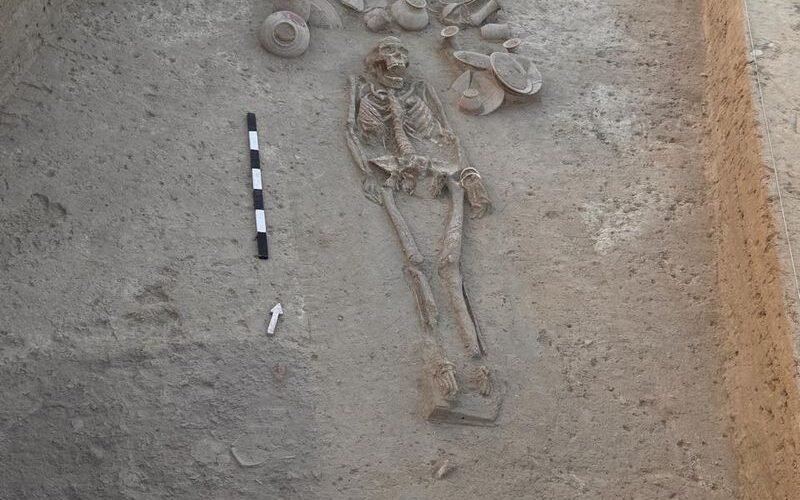
Rakhigarhi (Gurpreet Singh): The Archaeological Survey of India (ASI) has achieved a major breakthrough at Rakhigarhi, recognized as the most expansive site belonging to the ancient Indus Valley Civilisation. During its latest digging cycle, a team of researchers uncovered eight skeletal remains within a mature Harappan burial ground designated as Mound Number 7. ASI Superintending Archaeologist Manoj Saxena confirmed that five of these specimens have been successfully extracted, with three sent to the Anthropological Survey of India in Kolkata for physical examination and another specimen transferred to the Birbal Sahni Institute of Palaeosciences in Lucknow to undergo genetic sequencing.
Initial evaluations reveal that the intact remains consist of a male and two females who passed away in their 40s, whereas three other specimens showed signs of degradation caused by generations of local agricultural cultivation. Strikingly, investigators documented an unprecedented quantity of nearly 40 ceramic vessels placed alongside each individual, far exceeding the previous site record of 27 offerings. The female individuals were also interred with decorative shell bracelets still resting on their arms and surrounded by delicate gold beads, offering invaluable clues regarding the ritualistic and economic status of the community.
The fieldwork campaign, which spanned from late February until earlier this month across the 550-hectare historical zone, also featured the debut excavation of Mound Number 5. This sector exposed foundations of ancient homes, domestic hearths, daily utensils, and loose beads, indicating that the neighborhood served as a vital cultural and commercial marketplace roughly 4,000 to 5,000 years ago. This joint enterprise between the ASI and Deccan College, Pune, expands upon the 70 skeletons retrieved from the location over the last twenty years, with experts anticipating that upcoming laboratory results will significantly expand global knowledge of early urban societies.
