

Chandigarh (Gurpreet Singh): Punjab’s ongoing battle against drugs and organised crime is witnessing one of its strongest phases in recent years, with the Bhagwant Singh Mann-led government accelerating action against narcotics networks, gangsters and illegal assets across the state.
What began as a government campaign has increasingly evolved into a large public movement, with thousands of citizens participating in anti-drug awareness efforts and supporting law enforcement agencies in identifying drug traffickers and organised criminal networks.
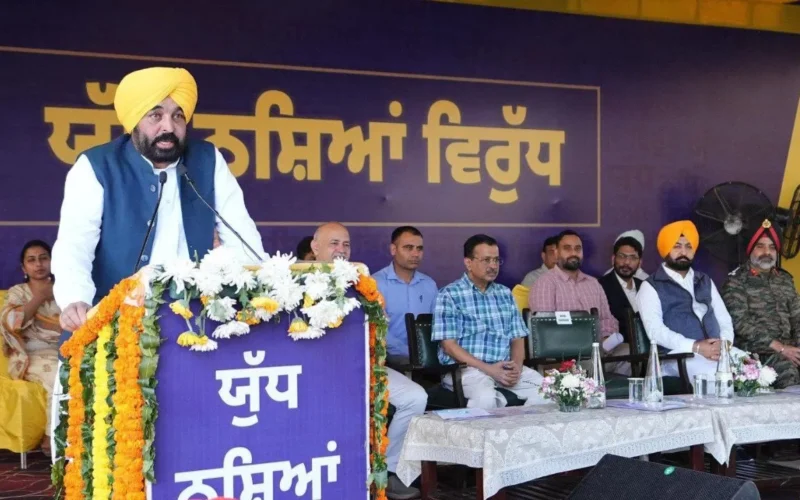
During an anti-drug awareness programme held in Batala on the occasion of the 38th Gurugaddi Divas of Sant Trilochan Das Ji Maharaj, Chief Minister Bhagwant Singh Mann highlighted the scale of the crackdown being carried out under the state’s “Yudh Nashean Virudh” campaign.
According to figures shared during the programme, Punjab Police has arrested more than 63,700 drug smugglers over the past 437 days. Alongside arrests, authorities have also launched action against properties allegedly built through drug money, with several illegal structures linked to smugglers being demolished in different districts.
The anti-drug campaign is being viewed as a major part of the Mann government’s larger promise to restore social stability and steer Punjab’s youth away from addiction. The administration has simultaneously focused on rehabilitation, de-addiction support and employment-linked initiatives aimed at reintegrating affected youth into mainstream society.
Officials say the state’s strategy has shifted from isolated enforcement actions to a broader coordinated model involving police operations, awareness campaigns, village participation and rehabilitation support. The government has also attempted to position the campaign as a fight to reclaim Punjab’s social fabric and protect future generations.
Parallel to the anti-drug drive, the Punjab Government’s “Gangstran Te Vaar” campaign has also intensified operations against organised crime. The Anti-Gangster Task Force, along with district police units, has been carrying out statewide raids and intelligence-based operations for the past 112 days in an effort to dismantle gangster networks operating across Punjab.
The government’s aggressive approach against drugs and crime has been accompanied by a parallel push on welfare and public services, which the administration has repeatedly projected as part of its commitment to rebuilding public trust.
Speaking at the event, Bhagwant Mann also highlighted the expansion of the state’s healthcare coverage under the Mukh Mantri Sehat Yojna. More than 30 lakh health cards have reportedly already been issued under the scheme, while over 1.65 lakh people have availed free treatment facilities. The initiative offers cashless medical treatment worth up to ₹10 lakh per family and has become a major welfare pillar of the government.
The Chief Minister also reiterated the rollout of the Maavan Dheeyan Satkar Yojna, under which women beneficiaries are set to receive monthly financial assistance. The scheme is being positioned as an effort to strengthen household financial security and support women-led welfare.
Observers note that the Punjab Government has increasingly attempted to combine strict law enforcement with welfare-driven governance, projecting both as interconnected parts of its vision for a “Rangla Punjab.” The administration has frequently highlighted free electricity, infrastructure projects, improved irrigation systems, government job recruitment and healthcare expansion as examples of promises being translated into visible action on the ground.
During the programme, Bhagwant Mann also referred to the recently enacted anti-sacrilege legislation, formally known as the Jaagat Jot Sri Guru Granth Sahib Satkar Amendment Act 2026, stating that stricter legal provisions had strengthened protection of religious harmony and helped address a long-pending public demand for stronger punishment in sacrilege-related cases.
The anti-drug awareness event at Sachkhand Nanak Dham in Batala witnessed participation from local residents, religious followers and youth groups, reflecting the growing public involvement in the state’s campaign against addiction and organised crime.
With enforcement drives continuing across districts and rehabilitation efforts being expanded simultaneously, the Punjab Government is increasingly positioning the anti-drug movement not merely as a policing exercise, but as a long-term social mission tied to the future of Punjab’s youth and public health.
