

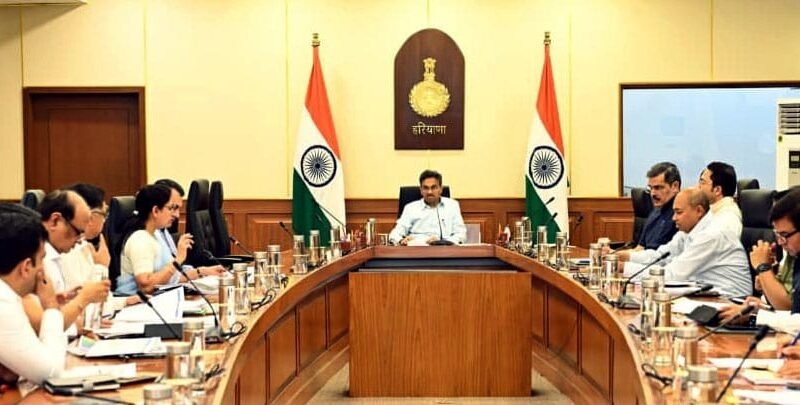
Chandigarh (Balwinder Singh): Haryana has officially shifted its focus toward the 2036 Olympic Games with the launch of a long-term talent identification program titled “Mission Olympic 2036-Vijayibhav.” Under this initiative, the state government aims to identify and nurture children in the 8 to 10-year age group, ensuring a steady pipeline of elite athletes for the next decade. Chief Secretary Anurag Rastogi chaired a high-level review meeting in Chandigarh on Monday, April 20, 2026, to assess the progress of this mission along with other key schemes related to education, nutrition, and higher education.
To ensure equal opportunities across the state, the government has introduced the “One District, One Sport” initiative. This program seeks to discover raw talent from every corner of Haryana, from Ambala to Nuh, by focusing on specific sports tailored to each district’s strengths. The Chief Secretary emphasized that the state’s progress is being measured through transparent, technology-based, and citizen-centric governance, aligning with the national vision of a developed India. The meeting also highlighted that the Nipun Bharat Mission, which focuses on foundational literacy and numeracy, will be extended to Class 5 by March 2027.
In the realm of early childhood care, Commissioner and Secretary of the Women and Child Development Department, Shekar Vidyarthi, reported significant strides in transforming over 4,000 Anganwadi centres into high-quality pre-school hubs. These centres have been equipped with educational kits, furniture, and RO drinking water facilities. To monitor health and academic progress, the state is accelerating the issuance of APAAR and ABHA digital IDs for all children aged 0 to 6 years. Furthermore, “Poshan Vatikas” are being developed at these centres to provide local, fresh produce to combat malnutrition effectively.
Higher education in Haryana is also receiving a boost through the Haryana State Research Fund (HSRF), established with an initial corpus of ₹20 crore. This fund provides research grants of up to ₹50 lakh for teachers and ₹5 lakh for students to encourage academic innovation. So far, 90 research proposals have been selected from 350 submissions. The meeting concluded with a call to universities to strengthen their alumni networks and focus on capacity-building workshops to fully implement the National Education Policy 2020.
