

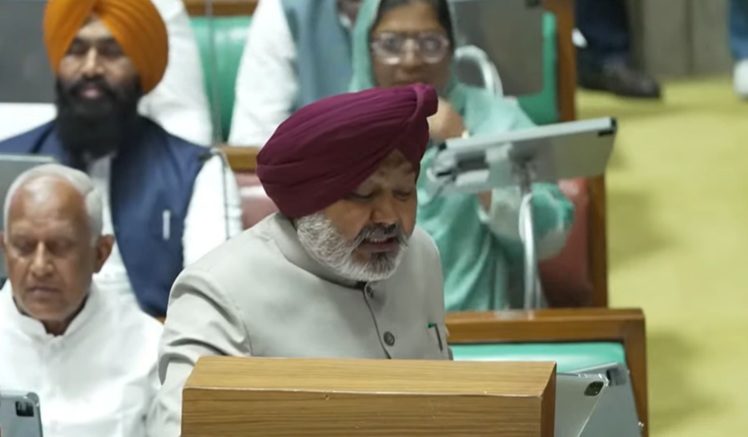
Chandigarh (Gurpreet Singh): The Punjab government on Sunday presented its Budget for the financial year 2026–27, outlining a series of welfare and development initiatives across key sectors. Finance Minister Harpal Singh Cheema described the plan as a Budget aimed at delivering on commitments made by the ruling Aam Aadmi Party.
The Budget, which has a total outlay of ₹2,60,437 crore, was tabled in the Punjab Vidhan Sabha on International Women’s Day, making it the first time the state’s Budget has been presented on a Sunday.
Emphasis on women’s welfare
The state government dedicated a major portion of the Budget to women-focused schemes. Among the key announcements was the ‘Mukh Mantri Mawan Dhiyan Satikar Yojana’, under which eligible women will receive a monthly financial assistance of ₹1,000, while Dalit women will be provided ₹1,500.
Nearly 97 percent of women in the state are expected to benefit from the programme. The government has set aside ₹9,300 crore to implement the scheme.
In addition, the free bus travel programme for women will continue, supported by an allocation of ₹600 crore. Funds have also been earmarked for social welfare measures including ₹932 crore under the Integrated Child Development Services programme and ₹65 crore for providing free sanitary pads to adolescent girls through the ‘Navi Disha’ initiative.
Overall, the government has earmarked ₹18,304 crore for women’s empowerment and related welfare schemes, significantly higher than last year’s allocation.
Health infrastructure expansion
The Budget includes increased investment in the healthcare sector, with ₹2,000 crore allocated for the Mukh Mantri Sehat Bima Yojana, which aims to provide health insurance coverage of up to ₹10 lakh to about 65 lakh families across the state.
The government also plans to strengthen primary healthcare by establishing 143 new Aam Aadmi Clinics and upgrading 308 existing health facilities into similar centres. An allocation of ₹351 crore has been set aside for this purpose.
Plans were also announced to build a trauma centre along with a specialised mother-and-child hospital in Anandpur Sahib.
Increased spending on education
Education remains another key focus area, with ₹19,279 crore allocated for the sector — a seven percent increase compared to the previous financial year.
The government plans to introduce the ‘Sikhiya Kranti 2.0’ initiative to further improve the school education system. The programme is expected to run for six years and will be implemented with support from the World Bank.
In addition, the government has approved the establishment of a university dedicated to Guru Tegh Bahadur in Anandpur Sahib. A total of ₹569 crore has been allocated for initiatives in higher and technical education.
Support for agriculture and farmers
Agriculture continues to receive significant attention, with ₹15,377 crore allocated to the sector. The Budget includes incentives for crop diversification, support for Direct Seeding of Rice and subsidies to manage crop residue burning.
The state has also allocated ₹7,715 crore for electricity subsidies for farmers. In addition, a ₹1,300 crore programme has been proposed to promote climate-resilient horticulture crops across the state.
Development funds for constituencies
Under the Rangla Punjab Vikas Fund, the government has announced ₹10 crore for development projects in each Assembly constituency. The total allocation for the scheme has been increased to ₹1,170 crore.
With the state expected to head toward Assembly elections in the coming year, this Budget marks the final financial roadmap presented by the AAP government during its current term.
