

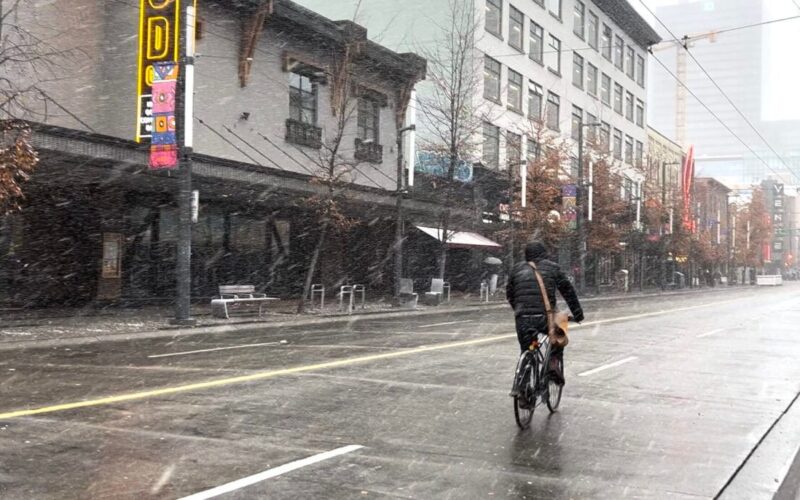
Vancouver (Rajeev Sharma): Vancouver has entered February without recording a single official snowfall at its airport weather station, raising the possibility that the city could experience its first snow-free winter in 43 years, according to Environment and Climate Change Canada.
Meteorologist Ken Dosanjh said that while winter is not technically over, current forecasts show no immediate likelihood of sea-level snow in the region. If Vancouver remains snow-free until spring, it would mark the first such winter since 1982–83, he noted.
Environment Canada attributed the unusually mild conditions to an unseasonably warm air mass, which also led to daily temperature records being broken across British Columbia on Tuesday. Communities such as Sandspit and Bella Bella exceeded previous record highs set in 1954 and 1998.
The warmth has been particularly evident in Metro Vancouver’s North Shore Mountains, where slopes typically covered in snow remain largely green. At Grouse Mountain, temperatures climbed to 12°C on Wednesday, leaving only seven of more than 30 ski runs open. The unseasonable weather also prompted Metro Vancouver Regional Parks to reopen the Grouse Grind hiking trail early, weeks ahead of its usual April opening.
Dosanjh explained that while there were reports of wet snow in parts of the city earlier in January, none accumulated or reached the ground at the Vancouver International Airport weather station, which is used for official records.
He added that a series of atmospheric rivers this winter has brought heavy rain while simultaneously raising freezing levels, causing any snowfall in the region to melt quickly. “I’m not seeing any glimpses of sea-level snow for at least the next nine days,” Dosanjh said, adding that a better chance may only emerge in mid to late February.
Across the South Coast of B.C., snowfall accumulation currently stands at about 78 per cent of the seasonal average, while Vancouver Island has received less than half of its normal snowfall, at 49 per cent, according to Environment Canada.
Meanwhile, the B.C. River Forecast Centre has issued a flood watch for the North Coast, including areas around Prince Rupert, Kitimat and Terrace, warning that up to 250 millimetres of rain could fall in some locations. Snowmelt combined with heavy rainfall is expected to increase runoff, raising the risk of flooding.
Environment Canada has also issued a rainfall warning, urging motorists to be cautious of potential road washouts near rivers, creeks and culverts.
