

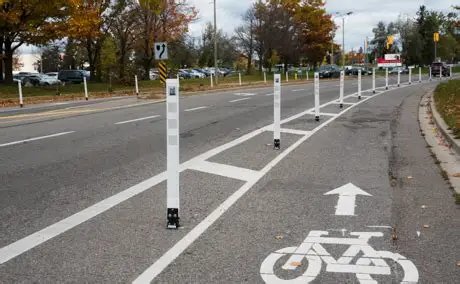
Toronto (Rajeev Sharma): A group of Toronto cyclists appeared before Ontario’s highest court on Wednesday to defend a lower-court ruling that blocked the provincial government’s plan to remove protected bike lanes from major city streets.
The Court of Appeal for Ontario is hearing the province’s appeal against a July 2025 Superior Court decision that found the proposed removal of bike lanes posed an unconstitutional risk to cyclists’ safety. The case centres on a 2024 law passed by Premier Doug Ford’s government to eliminate 19 kilometres of protected bike lanes along Bloor Street, Yonge Street and University Avenue.
The cyclists, including a bike courier and a university student, had successfully argued that the government’s plan to ease traffic congestion by removing bike lanes was not supported by evidence and would endanger lives. Superior Court Justice Paul Schabas ruled that both government advisers and external experts broadly agreed the plan would not reduce congestion and could even worsen traffic.
In his decision, Schabas noted that even if the government’s claim of marginally improved traffic flow were accepted, the resulting harm to cyclists would be grossly disproportionate to the benefit of saving some drivers a few minutes of travel time. He found that removing or reconfiguring protected bike lanes would likely lead to increased accidents, injuries and deaths.
The judge also pointed to an immunity clause added by the province to shield itself from liability, saying it showed the government recognized the safety risks involved. A 2024 City of Toronto staff report cited in court found the risk of cyclist injury on major streets without protected lanes was about nine times higher than on roads with separated bike infrastructure.
According to the report, 28 cyclists have been killed and 380 seriously injured in Toronto over the past decade, with nearly two-thirds of serious crashes occurring on streets without safe bike lanes.
During the original proceedings, the province amended its legislation to state that bike lanes would be “reconfigured” rather than removed. Schabas dismissed the change as a distinction without substance, saying it appeared to be an attempt to sidestep the court’s judgment.
In its appeal, the province argues the judge erred in finding that the bike lane removals would violate the Charter right to life, liberty and security of the person. The government maintains that the Charter was never intended to subject any legislation with safety implications to judicial scrutiny.
Premier Doug Ford has publicly criticized the ruling, calling it ideological and ridiculing the idea of judges interfering in elected governments’ decisions. Ford has said he is not opposed to bike lanes but wants them moved off arterial roads and onto secondary streets.
However, evidence presented in court suggested there are no feasible alternative routes on secondary roads for many of the affected stretches without creating fragmented and more dangerous cycling networks.
Toronto Mayor Olivia Chow’s office said the city has been working with the province on “win-win” solutions that preserve both vehicle lanes and protected bike lanes. The city previously estimated the cost of removing the bike lanes at $48 million, an estimate the province questioned without offering its own figures.
In October, Transportation Minister Prabmeet Sarkaria announced a partial compromise, saying bike lanes would remain on a short stretch of Bloor Street with barriers and bollards at a cost of $750,000, while vehicle lanes would be restored elsewhere. Chow welcomed the move, though Cycle Toronto, the advocacy group leading the court challenge, questioned whether such solutions were viable across all targeted routes.
Ahead of the hearing, Cycle Toronto executive director Michael Longfield said the case was about upholding the rule of law. He accused the government of engaging in a “bad-faith culture war” despite expert advice, at a time when Ontarians need practical solutions to real challenges.
