

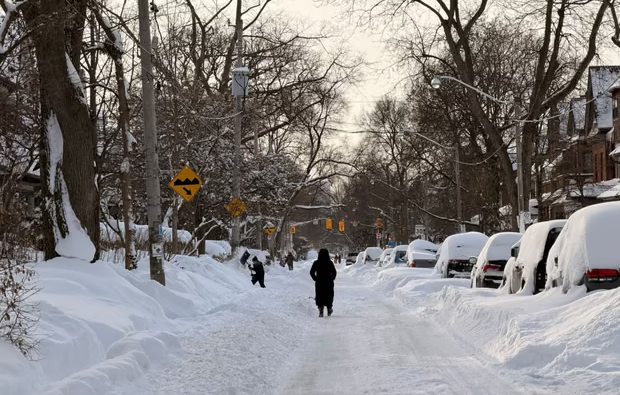
Toronto (Rajeev Sharma): Toronto is working to recover from the heaviest snowfall in its history, with city officials warning that clearing the streets and infrastructure could take several days.
Some areas of Canada’s largest city were buried under nearly 60 cm (about 23 inches) of snow, forcing the cancellation of over 500 flights at Toronto Pearson International Airport on Sunday. The airport has already recorded more than 88.2 cm of snowfall this month, making it the snowiest January and the snowiest month on record since 1937.
The weekend storm, which affected much of North America, led several school boards to announce closures on Sunday evening—a rare move that delighted Toronto students, giving them their second snow day of January.
Traffic conditions were treacherous, with more than 430 collisions reported in the city and another 200 in surrounding areas, including one fatal accident. Police cautioned drivers about snowbanks created by plows, which could cause vehicles to launch off the roadway if hit at the wrong angle. Residential streets, particularly downtown, remained difficult to navigate.
Toronto’s transit system, serving over a million commuters daily, faced widespread disruptions. On one key route, a streetcar derailed, while subways were halted in sections exposed to heavy snowfall.
City Manager Paul Johnson said clearing priority will be given to major roads before residential streets and sidewalks. In addition to plows, city workers are manually removing snow in several areas. “This is going to be a plowing day, and then we’re going to have to shift into removal time once we get through today and into tomorrow,” Johnson said. Residents can track progress using the city’s GPS tool, PlowTO.
Beyond Toronto, the storm caused widespread disruption across North America. Flights were cancelled in parts of the U.S., and ice storms created hazardous road conditions and power outages, contributing to at least 13 weather-related fatalities.
Despite the challenges, many Torontonians embraced the snowfall, with children sledding and families skiing along quiet streets. Meteorologist Bill Coulter from CP24 noted that Lake Ontario’s location played a significant role in the heavy accumulation. He explained that Arctic air colliding with tropical moisture created the “monster” storm, producing far more snow than initially predicted.
“What a winter wallop for Toronto,” Coulter said, highlighting the city’s extraordinary snow record. Residents are bracing for days of cleanup, but many are making the most of the rare winter spectacle.
