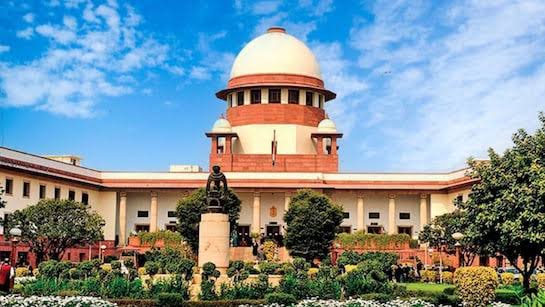
New Delhi (Rajeev Sharma): The Supreme Court on Wednesday directed the Centre, the Delhi government and other concerned agencies to submit detailed action plans within four weeks, outlining how they will implement long-term measures to tackle the worsening air quality in the Delhi-NCR region.
A three-judge bench headed by Chief Justice of India Surya Kant, along with Justices Joymalya Bagchi and Vipul M Pancholi, issued the direction after examining a status report filed by Additional Solicitor General Aishwarya Bhati on behalf of the Commission for Air Quality Management.
The court was informed that the CAQM has recommended 15 long-term measures and has clearly identified the agencies responsible for executing each of them. While observing that additional steps may be required in the future, the bench stressed that the existing recommendations must be implemented without delay. It made it clear that no objections to these measures would be entertained and asked all stakeholders to place their action-taken plans on record within the stipulated timeframe.
Emphasising the need for execution over discussion, the bench noted that effective and timely implementation is essential to address the persistent pollution crisis that grips the national capital every year.
Bhati told the court that the proposed roadmap includes phasing out highly polluting vehicles from the Delhi-NCR region based on emission levels, strengthening the Pollution Under Control regime, expanding rail and metro connectivity, and revisiting the electric vehicle policy. She also informed the bench that mechanisms have been identified to create an environmental compensation fund to ensure smooth implementation of the measures.
Senior advocate Aparajita Singh, appearing as amicus curiae, pointed out that many of the recommendations have featured in earlier plans as well. She urged the court to ensure that clear timelines are fixed so that the measures do not remain confined to policy documents.
The apex court’s firm approach follows its earlier criticism of the CAQM. On January 6, the court had expressed dissatisfaction with the authority’s functioning, observing that it appeared to be “failing in its duty” after seeking a two-month adjournment on issues such as the temporary closure or relocation of toll plazas at Delhi’s borders to ease traffic congestion.
The bench has repeatedly described Delhi’s pollution crisis as an “annual feature” and has called for pragmatic and time-bound solutions. In December, it reiterated the urgency for decisive action and later modified its interim order of August 12, allowing authorities to take coercive steps against older vehicles that do not meet Bharat Stage-IV emission standards.
With air quality in the Delhi-NCR continuing to deteriorate year after year, the latest order signals a renewed push by the Supreme Court for accountability and swift implementation of long-pending structural reforms.
Supreme Court Seeks Time-Bound Action Plans to Implement Long-Term Measures on Delhi-NCR Air Pollution
 0 Comments