

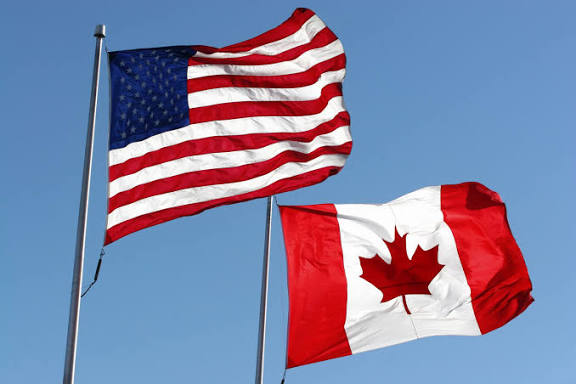
Ottawa (Rajeev Sharma): Canada is likely to face the most severe consequences of political instability in the United States next year, according to a new report released by global risk consultancy Eurasia Group on Friday. The firm cautioned that rising uncertainty in Washington and a hardening trade environment could significantly reshape Canada’s economy and its long-standing relationship with its closest ally.
The report argues that the traditional Canada–US partnership has entered a fundamentally different phase, driven by US President Donald Trump’s return to the White House and his confrontational approach to governance and trade. It warns that Trump’s efforts to consolidate power domestically and use state institutions against political opponents will have far-reaching implications beyond US borders.
Eurasia Group said Canada will be forced to simultaneously defend its economic and political interests against an unpredictable United States while also seeking new opportunities in what it described as an increasingly unstable “G-Zero” world, where no single power provides global leadership.
According to the report, Ottawa’s attempts to diversify trade and strengthen ties with other countries will face strong headwinds in 2026. While Canada will continue to rely heavily on the US market, it will also need to deepen engagement elsewhere to reduce long-term vulnerability.
Relations between the two countries deteriorated sharply after Trump returned to office in 2024, marked by his repeated threats and remarks questioning Canadian sovereignty. Since then, Washington has imposed multiple tariffs on Canadian exports, including steel, aluminium, automobiles and lumber, dealing a blow to key sectors of the Canadian economy.
The report noted that recent US actions, including a military operation in Venezuela, signal Washington’s intent to assert dominance across the Western Hemisphere. This posture, it said, would likely keep Canada on the defensive, forcing Prime Minister Mark Carney’s government to carefully balance the defence of national sovereignty with the economic reality of deep dependence on the US.
Eurasia Group warned that Canadian businesses and investors risk becoming “collateral damage” as Washington increasingly uses trade tools and tariffs as political leverage. It also raised concerns over the future of the USMCA trade agreement, calling it a potential “zombie deal” that may neither be fully renewed nor scrapped, but instead linger in a state of uncertainty.
While tariff exemptions for USMCA-compliant goods are expected to remain in place, the report said sector-specific tariffs on autos, steel and aluminium could continue to be used by the US to pressure Canada and Mexico in prolonged negotiations.
The report also highlighted challenges beyond North America. It said Europe’s political divisions could limit Canada’s ability to rapidly expand trade and strategic ties there, even as defence rearmament creates new commercial opportunities. At the same time, it warned that increased Russian hybrid activity could draw Canada into heightened NATO-related tensions due to its strong support for Ukraine.
On China, Eurasia Group cautioned that Beijing’s slowing economy could flood global markets with cheap goods, posing risks to Canadian manufacturing, particularly the automotive sector, and potentially triggering fresh frictions with the US. Prime Minister Carney is scheduled to meet Chinese President Xi Jinping in Beijing next week, marking the first official visit by a Canadian prime minister to China in over eight years as Ottawa seeks to stabilise strained relations.
The report also touched on artificial intelligence, warning that US resistance could emerge if Canada pushes ahead with stricter AI regulation. However, it noted that Canada’s strength lies in developing smaller, specialised AI models, a niche where the country could emerge as a global leader if it maintains funding and retains talent despite external pressure.
Eurasia Group concluded that Canada’s ability to navigate 2026 will depend on its success in managing US unpredictability while building resilient economic and strategic partnerships elsewhere.
