

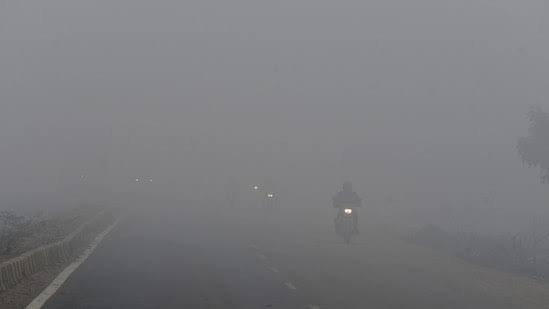
New Delhi, January 2, 2026: A ‘yellow’ alert has been issued for Delhi with dense fog likely to reduce visibility across the national capital on Saturday morning, the India Meteorological Department (IMD) said, warning of challenging weather conditions over the next few days.
The weather office has also predicted a cold wave in isolated areas of Delhi and Haryana between January 3 and January 6. According to IMD norms, a cold wave is declared when minimum temperatures fall 4.5 to 6.5 degrees Celsius below the seasonal average.
On Friday, Delhi recorded a notable improvement in air quality, with the 24-hour average Air Quality Index (AQI) dropping to 236 from 380 a day earlier. Despite the improvement, air quality remained in the ‘poor’ category.
The maximum temperature on Friday settled at 17.4 degrees Celsius, nearly two degrees below normal, while the minimum temperature was recorded at 9.1 degrees Celsius, slightly above the seasonal average.
Among monitoring stations, Lodhi Road reported a maximum of 17.4 degrees Celsius, Ayanagar 17.2 degrees Celsius, Palam 16.4 degrees Celsius and the Ridge 14 degrees Celsius. Minimum temperatures ranged between 8.1 degrees Celsius in Ayanagar and 9 degrees Celsius at Palam and Lodhi Road.
For Saturday, the IMD has forecast a minimum temperature of around 7 degrees Celsius and a maximum of about 18 degrees Celsius, with dense fog expected during the morning hours.
Visibility levels dipped significantly in the early hours of Friday, with Safdarjung recording the lowest visibility at 800 metres between 1.30 am and 2 am, which later improved to 1,200 metres.
Air quality data from the Central Pollution Control Board’s SAMEER app showed mixed conditions across the city. By evening, 15 monitoring stations were in the ‘moderate’ category, 20 in ‘poor’ and one in ‘very poor’, with NSIT Dwarka registering the worst AQI at 367. Morning readings placed the city’s overall air quality in the ‘very poor’ category, with an AQI of 302.
According to the Decision Support System, transport emissions were the biggest contributor to Delhi’s pollution load at 11.11 per cent, followed by peripheral industries at 8.4 per cent. Residential sources contributed 2.8 per cent, construction activities 1.4 per cent and waste burning one per cent.
Among NCR districts, Baghpat accounted for 8.2 per cent of the pollution contribution, followed by Muzaffarnagar at 7.5 per cent, Sonipat at 7.1 per cent, Meerut at 4.2 per cent, Jhajjar at 3.4 per cent, Gautam Budh Nagar at 2.2 per cent and Ghaziabad at 1.8 per cent.
