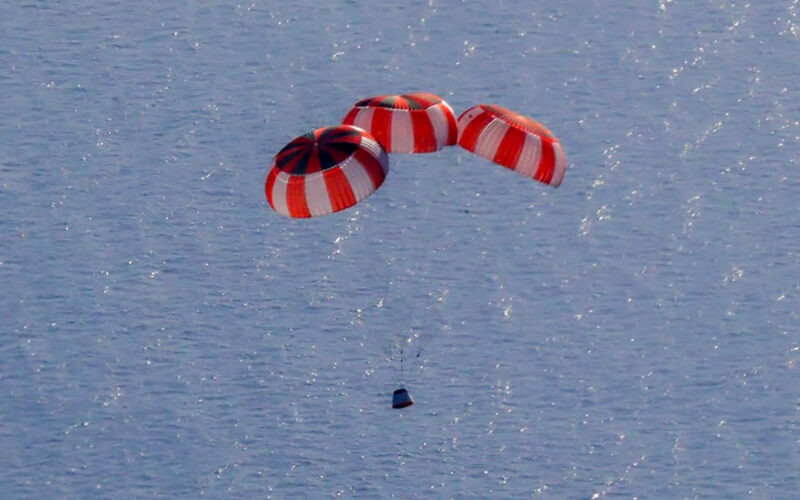
Jhansi, November 11, 2025 — The Indian Space Research Organisation (ISRO) announced the successful completion of a crucial parachute test for its ambitious Gaganyaan mission. The trial, held on November 3 at the Babina Field Firing Range (BFFR) in Jhansi, marked another major step toward India’s first human spaceflight.
According to ISRO, the test was part of the ongoing Integrated Main Parachute Airdrop Tests (IMAT) designed to validate the safety and performance of the parachute system that will ensure the crew module’s safe landing. The Gaganyaan mission aims to send a three-member crew into space for a three-day mission and return them safely to Earth.
The Crew Module’s parachute system consists of 10 parachutes of four types. The sequence begins with two apex cover separation parachutes that open the compartment, followed by two drogue parachutes that stabilise the descending module. Three pilot parachutes then deploy three large main parachutes, which slow down the spacecraft for a safe touchdown. ISRO said the system includes redundancy, allowing even two of the three main parachutes to ensure a secure landing.
A unique feature of the design is the reefed inflation process, where the parachute first opens partially before fully deploying after a short delay. This staged inflation is controlled by a pyrotechnic device that regulates timing and pressure balance during descent. The latest test simulated an extreme scenario involving delayed deployment of one main parachute, successfully proving the system’s stability under stress conditions.
A test mass replicating the Crew Module was dropped from an Indian Air Force IL-76 aircraft from a height of 2.5 kilometres. The parachutes deployed as expected, achieving a steady descent and soft landing, confirming the system’s reliability.
ISRO stated that the success of this test marks “a major milestone” in qualifying the Gaganyaan parachute system for human spaceflight. The exercise was carried out with the participation of the Vikram Sarabhai Space Centre (VSSC), Aerial Delivery Research and Development Establishment (ADRDE) of DRDO, the Indian Air Force, and the Indian Army.
The Gaganyaan project, one of India’s most ambitious space missions, involves developing a human-rated launch vehicle, an orbital module, and a robust crew escape system. Unmanned test missions are scheduled before the final manned flight to ensure every safety system functions perfectly.
Indian Space Research Organisation (ISRO) Executes Critical Parachute Test for Gaganyaan Crew Module Module in Jhansi
 0 Comments