

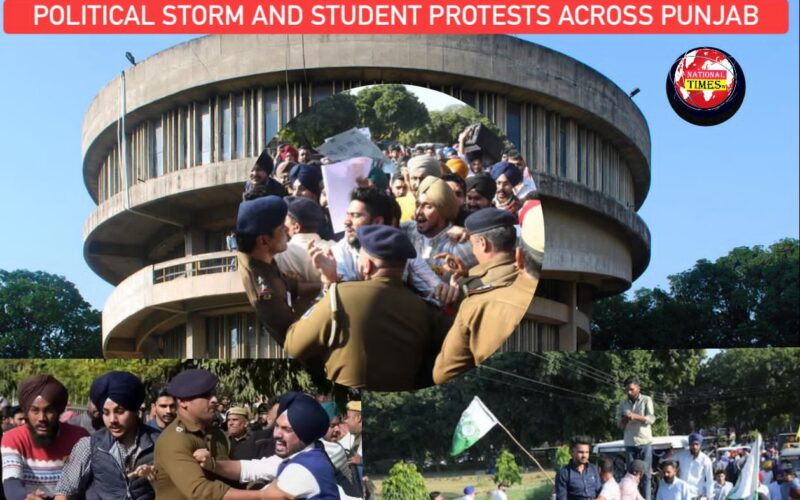
Chandigarh (Gurpreet ): A major controversy has erupted at Panjab University (PU) after the Central Government’s decision to restructure the university’s Senate and Syndicate, sparking widespread protests from student organizations, faculty associations, and political parties across Punjab. The move is being seen as a direct challenge to the university’s democratic traditions and the state’s historical connection to the institution.
On October 28, 2025, the Ministry of Education issued a notification under the Panjab University Act, 1947, introducing sweeping changes to the university’s governance structure. The Senate’s strength was reduced from about 90 members to 31, while the Syndicate, which was previously an elected decision-making body, was transformed into a fully nominated entity. The graduate constituency which allowed PU graduates to elect representatives was also abolished.
While the Centre maintains that these reforms are aimed at “streamlining administration and improving efficiency,” critics argue that they represent a centralization of power and a dilution of Punjab’s participation in the university’s affairs.
The decision has drawn sharp criticism from across the political spectrum. Leaders from the Aam Aadmi Party (AAP), Congress, and Shiromani Akali Dal (SAD) have called the move “unconstitutional” and “an assault on Punjab’s educational autonomy.” Punjab’s Education Minister warned that the changes threaten to “undermine the state’s historical and cultural association with the university.”
Student bodies, including the Panjab University Students’ Union (PUSU) and SOPU, have launched indefinite protests on campus, demanding that the Centre withdraw the notification completely and restore the democratic structure of the Senate and Syndicate. Faculty associations have also joined the agitation, terming the move “a step toward erasing the university’s democratic character.”
Amid the escalating protests, the Centre on November 6, 2025, temporarily paused the implementation of its earlier order. However, student and faculty leaders have dismissed the move as “mere eyewash,” insisting that demonstrations will continue until the government formally revokes the decision.
Observers note that the controversy has gone beyond academic governance, becoming a symbolic battle over federal rights and Punjab’s cultural identity. Legal experts have also raised concerns over whether such changes can legally be introduced through a simple administrative notification rather than parliamentary amendment.
As the standoff continues, Panjab University remains at the center of a heated debate on autonomy, regional representation, and academic freedom issues that strike at the very core of India’s higher education framework.
