

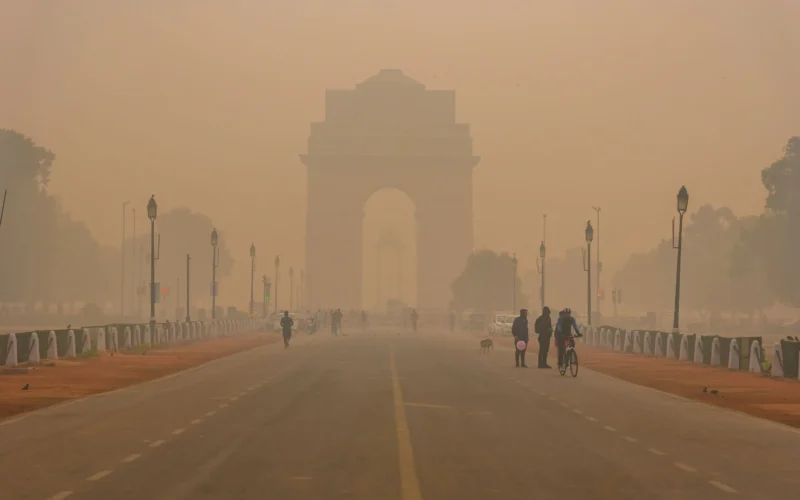
New Delhi (Rajeev Sharma): Delhi’s skyline disappeared once again behind a blanket of smog on Sunday morning as air quality across the capital deteriorated sharply, reaching the ‘severe’ category for the first time this month.
According to the Central Pollution Control Board (CPCB), the city’s overall Air Quality Index (AQI) was recorded at 391 at 7 a.m., with several parts of the capital registering levels beyond 400 — an indication of dangerously high pollution.
The city’s outer and industrial areas were hit the hardest. Bawana topped the pollution chart with an AQI of 436, followed closely by Patparganj (425), RK Puram (422), and Anand Vihar (412). The densely populated areas of Chandni Chowk (409), Alipur (415), and Sonia Vihar (415) also reported air quality in the “severe” range.
Officials said stagnant winds and low temperatures overnight allowed pollutants to accumulate, worsening the smog that has gripped Delhi since Diwali. On Saturday, the city’s air quality was already in the ‘very poor’ range, with an AQI of 355.
“The pollution levels are rising steadily, and the calm weather conditions are not allowing the particulate matter to disperse,” said a senior CPCB official. “We expect some improvement only if wind speeds pick up.”
In response, the Graded Response Action Plan (GRAP) Stage II remains active across the National Capital Region (NCR). Under this plan, authorities have implemented a series of emergency steps, including doubling parking fees, restricting construction activities, and urging residents to use public transport or carpooling options.
Health experts have warned citizens to minimize outdoor exposure and avoid morning walks or outdoor exercise until conditions improve. “The air is thick with PM2.5 particles, which can penetrate deep into the lungs and cause long-term respiratory problems,” said Dr. Meena Arora, a pulmonologist at Safdarjung Hospital.
Environmentalists have once again called for stronger inter-state coordination to tackle stubble burning, one of the key contributors to Delhi’s annual smog crisis. Satellite data over the past week has shown a rise in farm fire incidents across Punjab and Haryana.
As visibility dropped in several parts of the city and a faint burning smell lingered in the air, residents expressed frustration over what has become an annual ordeal. “Every winter it’s the same story — we shut our windows, use air purifiers, and still can’t breathe properly,” said Rohit Malhotra, a resident of Laxmi Nagar.
With no immediate weather relief on the horizon, experts fear the city may remain trapped under a toxic haze for several more days — a grim reminder of how dangerous Delhi’s winter air has become.
