

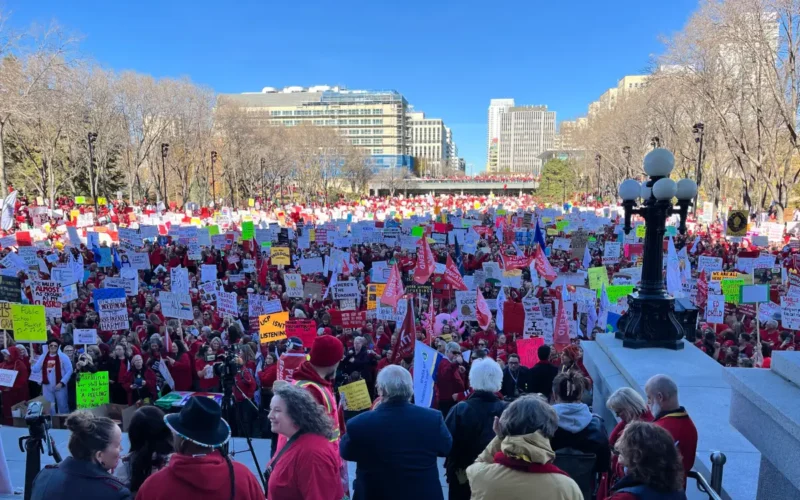
Calgary (Rajeev Sharma): As Alberta’s teachers’ strike enters its fourth week, hundreds of educators and public education supporters gathered Saturday in Calgary-Bow, the home riding of Education Minister Demetrios Nicolaides, to protest looming back-to-work legislation expected to be tabled Monday.
The demonstration, organized by Public Interest Alberta, saw members of the Alberta Teachers’ Association (ATA) and allies canvassing the southwest Calgary community of West Springs, distributing yellow signs and urging residents to support stronger funding for public schools.
The strike, now in its 22nd day, has left approximately 750,000 K–12 students across the province out of classrooms since October 6.
‘This is Their Strike’
Bradley Lafortune, executive director of Public Interest Alberta, accused the government of mishandling the dispute.
“This is Danielle Smith’s strike, and this is Minister Nicolaides’ strike,” Lafortune told reporters. “They had the power to stop this before it began. Instead, teachers have spent three weeks on picket lines fighting for smaller class sizes, fair wages, and sustainable funding.”
Lafortune warned that the Back to School Act (Bill 2), expected to be introduced Monday, would strip educators of their right to strike.
“We’re here to hold them accountable,” he said. “The right thing to do is to negotiate — not legislate.”
Recall Petition Adds Pressure
Although a recall petition targeting Nicolaides was being circulated at the event, organizers insisted the protest and petition drive were separate. The petition, approved on October 23, is the first officially sanctioned under Alberta’s amended Recall Act. To succeed, it must collect 16,006 signatures — 60 percent of voters from the last provincial election — by January 21, 2026, triggering a recall referendum.
Premier Smith Defends Legislation
Speaking on her weekly radio show, Your Province, Your Premier, on Saturday, Premier Danielle Smith confirmed that her government will move forward with the back-to-work bill on October 27, arguing that the province “cannot leave students out of classrooms indefinitely.”
“We’ve heard teachers’ concerns about classroom complexity,” Smith said, “but not every issue can be bargained at the table.”
Smith criticized the ATA for rejecting the province’s offer of enhanced mediation, which would have allowed teachers to resume work while negotiations continued. She said the legislation will ensure a balance between the rights of teachers, parents, and taxpayers.
The premier reaffirmed the government’s proposed 12 percent wage increase over four years and the creation of 3,000 new teaching positions, saying a broader “task force” will follow to address classroom-specific challenges.
“Each classroom is different,” Smith said. “We’ll take a classroom-by-classroom approach — more classrooms where needed, smaller ones where possible, and more specialized support for complex learning needs.”
Teachers Remain Skeptical
ATA President Jason Schilling expressed doubts about the government’s promises, saying teachers have seen similar “task force” commitments in the past with little tangible outcome.
“They never followed through,” Schilling said. “Teachers have learned not to trust vague assurances. They need real policy changes, not more studies.”
He added that the union’s proposal to limit class sizes and address workload concerns would cost roughly $2 billion — an amount he argued the province could easily manage.
“There’s money in the budget,” Schilling said. “It’s just a question of political will.”
Growing Political Tension
The confrontation between the Smith government and Alberta’s educators has become one of the most divisive labour disputes in recent provincial history. With legislation expected to force teachers back to work as early as next week, tensions are expected to remain high both in classrooms and at the legislature.
